
What protein powder and lead can tell us about the risks of direct-to-consumer testing
The Thing About ProblemMaxxing (Part 1)
Last week (October 14 for those in the Archives), Consumer Reports released another installment in their ongoing, headline-grabbing “you probably own or enjoy something that contains something toxic” series. You might already know them from such hits as lead in your boba tea, lead in your chocolate, heavy metals (including lead) in your organic tampons and lead (and arsenic and cadmium) in your baby’s food.1 This time around— and just in time for National Lead Awareness week, no less— Consumer Reports is warning us all about lead in protein powder. Given the increasing focus on protein consumption (including ProteinMaxxing trends), there is certainly no blame in scrutinizing the contents products from the largely unregulated supplement industry from which protein powers are born. However, it is the way that Consumer Reports goes about their investigation and reporting that deserves attention. What can tests about lead in protein powder teach us about the billion-dollar (and growing) direct-to-consumer lab testing industry that serves as a point of entry into the worlds of evidence-light grey-zone medicine and evidence-poor wellness trends?
How to ProblemMaxx
Let’s start with the very heavy elephant in the room: Protein power, Consumer Reports and lead. Consumer Reports performed an independent study of 23 commercially-available protein powders and determined that “about 70 percent of products we tested contained over 120 percent of CR’s level of concern for lead, which is 0.5 micrograms per day.” Furthermore, they found that two products contained 1,570% and 1,290% “of CR’s daily lead limit.”
The report then included some attractive graphics to underscore their concerns, as follows:
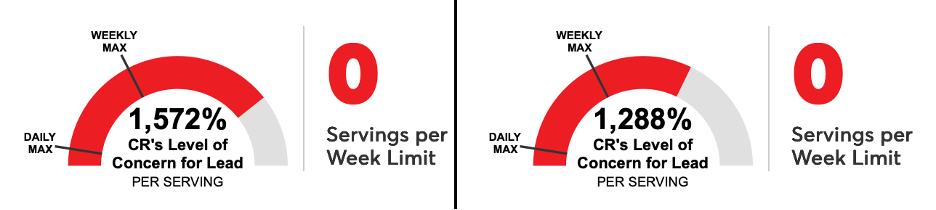
Yikes! That’s a lot of red!
Or is it…?
Here’s the issue: The wording of Consumer Reports’ report is important, especially with respect to ProblemMaxxing. Everywhere in the report, CR keeps referring to “CR’s level of concern” or “CR’s daily limit.” That’s a bit odd. Why not report this in terms of standards set by the FDA or the WHO, scientific bodies that carry some more scientific and regulatory weight (current administration’s hijinks aside)? As it turns out, doing so would lead to results (and graphics) that are a lot less alarming. Let me explain:
The dietary lead “limit” that CR’s internal experts have chosen to adopt in their analysis comes from the California Prop 65 cancer warning thresholds (you know, the thing that shows up on almost everything you buy), which in the case of lead is 0.5 micrograms per day. For years, Prop 65 warnings have been the subject of much ridicule, their ubiquitous presence due to exceptionally– and sometimes nonsensically– low thresholds.
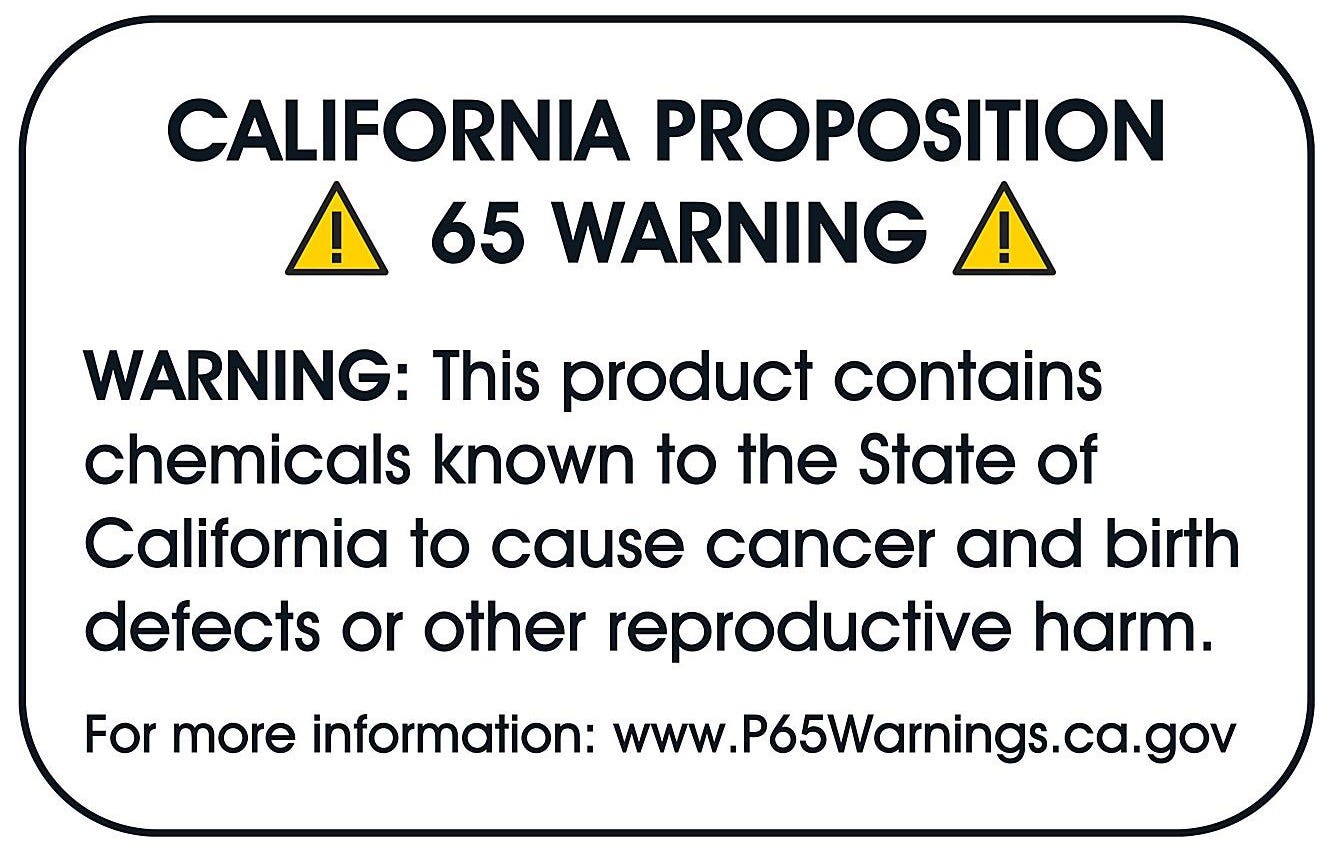
Regarding their decision to adopt this particular threshold for their analysis, Consumer Reports’ methodology states:
“CR uses these values because the standards are the most protective available.”
Yet this logic is problematic. The term “most protective available” is arguably very subjective. Protective from what and in what way? And based on what? California Prop 65’s warning labels are only concerned with the possible cancer risk– not any other health effect– as extrapolated from animal studies. This issue here is since we’re no longer soaking in lead-laden car exhaust, lead-induced cancer is now incredibly uncommon and of low concern. In our modern times, the more realistic concerns are age group-specific lead-induced neurological and cardiovascular impacts.
Fortunately, we do have human data on these effects based in the form of far more relevant blood concentrations. With a little math, we can therefore reasonably set dietary exposure thresholds to prevent development of those blood concentrations. Unfortunately for Consumer Reports, the FDA has set those thresholds to 2.2 micrograms/day for children and 8.8 micrograms/day for child-baring-aged women.2
Those playing along will note that the FDA-defined daily intake limits are 4-18 times higher than the threshold adopted by Consumer Reports. And even at that, they are still conservative insomuch as they would predict a blood lead level of 0.5 micromols per liter, which is roughly 10 times lower than actionable thresholds set by the CDC and WHO, respectively.
In other words, just because the lead was detected in these powders does not indicate that there is inherent risk.
Consumer Reports even says this themselves (in a separate methodology article):
“Our results are meant to provide guidance on which products have comparatively higher levels of lead, not to identify the point at which lead exposure will have measurable harmful health effects.”
Thus, Consumer Reports has taken a problem (and lead in food is decidedly problematic) and ProblemMaxxed it by adopting an inappropriately low threshold, leading to big, attention-grabbing percentages and red-lined graphs, risking yet another toxic panic.
What happens when you use clinically meaningful numbers
If we redraw these graphics to adopt thresholds for which there has been demonstrated adverse human health effects, the most eye-catching graph and figure starts to look something like this:

So, when looking at the same data for a supplement containing 7.7 micrograms of lead per serving, the FDA health limits indicate that the lead content is both above the limit for children, or below the limit for child bearing-aged women.3 Can something really be both harmful and not harmful at the same time? Yes, because context is king!
Since most children are not getting a daily dose of protein powder, the overall risks– based on Consumer Reports' own measurements— are below the threshold for expected human health effects. Now, should protein power contain lead? No. But is the problem as Maxxed-out as Consumer Reports has suggested? Also no.
ProteinMaxxers be reassured: you probably don’t have lead toxicity from your protein powder.
All jokes aside, one of the many unfortunate issues that has arisen from the Consumer Reports article is that it does contain valid points regarding the absurdity of the ProteinMaxxing trend. The authors note correctly that the average human body with an average diet does not need excess amounts of supplemental protein. However, instead of sticking to the nutritional science and reminding readers of the importance of the middle road of moderation, they have clouded the conversation by trying to use excessive lead as the vehicle to underscore their argument. In doing so, they have lost the point among the noise. By ProblemMaxxing, have undermined their own credibility!
What this episode shows us is one example of how manipulation of testing thresholds can grossly mischaracterize a problem. Consumer Reports has done so (again and again) to gain maximum exposure on a national stage, driving subscriptions and profits. Obviously, Consumer Reports is not alone in this practice. We see this all the time in articles submitted to peer-review medical journals, many of which don’t even make it to the published page (though the peer-review process is, itself, in a dreadful state these days).
As we’ll see Part 2 of the Thing About ProblemMaxxing, the time-tested technique of setting your own rules is a key practice that drives the billion-dollar direct-to-consumer testing market, which serves as an entry point into the multi-trillion dollar health and wellness industry, evidence be damned!
Next time: Heavy metals, predatory labs and the DIY era of medicine and health.

Until then, thanks for spending some time with A Thing About Poison. Please share a little poison with your friends!
Taking a moment to call out toxicology’s best heteronym. It’s remarkable that lead (the metal), lead (the verb), and lead (the noun) all exist in the same language. And while I could just use Pb, that reads weird and makes me look like (more of) a nerd (than I am). Just for fun: Elevated lead levels have lead to initiatives that can lead the way for improved public health, except that leaders have recently reduced funding to these programs, which will likely lead to increased lead exposure in our underserved communities.
Set during the “closer to zero” campaign lead by officials that have spanned both the Biden and Trump administrations, for those that care.
Deeper dive:
It should be noted that the current daily exposure limit for children and adults are widely different due to the differences in the toxicological effects of Lead on each group. Children are most sensitive to the neurodevelopmental effects of elevated Lead levels due to the rapid brain development, especially in the first 5 years of life, when important neural pathways and connections are being made. Think of this like a tree rapidly sprouting all the little branches that are currently spitting leaves across my lawn. In fact, it’s actually called arborization.
Once we’re in our adult years, our brain is well-beyond the neurodevelopment stage and is actually shrinking– neural branches are slowly cut away through focused use, disuse or abuse (and YouTube). Thus, the concerning effects of Lead shift towards the cardiovascular issues, which occur at higher blood Lead levels. The threshold for child-bearing-aged women is, itself, lower than the average adult due to the fact that Lead can cross the placenta and be problematic for fetal neural growth. Therefore, the daily dietary limit for adult males is actually even higher than listed above.